Treating the wireless signals of everyday devices as a new kind of biometric for secure, seamless human–robot interaction.
 Figure 1. Treating the wireless signals of everyday devices as a new kind of biometric for secure, seamless human–robot interaction.
1. Overview
This project explores how radiometric fingerprints of wireless devices can be used as a new kind of biometric signal for identifying and authenticating people in the physical world.
Instead of relying only on passwords, cards, or cameras, we use the subtle, device-specific distortions that appear in the physical-layer waveforms transmitted by smartphones, wearables, and IoT devices. By combining these fingerprints with deep learning and edge computing, we aim to:
- Continuously and unobtrusively recognize who is present in a space based on the devices they carry.
- Enable robots and smart environments to cooperate with humans in a secure and personalized way.
- Provide an additional layer of privacy-aware authentication, without requiring the user to present a face or touch a sensor.
Our long-term vision is a platform where robots and cyber-physical systems can safely interact with people using their everyday wireless devices as a secure, ambient identity signal.
2. Background and Motivation
Wireless devices are now tightly coupled to individuals: most people carry a smartphone, smartwatch, earphones, and other connected devices throughout the day. At the same time, these devices emit rich RF signals (Wi-Fi, BLE, etc.) that already pervade our environments.
Conventional authentication approaches (passwords, ID cards, face recognition) have several limitations:
- They are intrusive or interrupt user behavior.
- They often rely on single-modal sensors with line-of-sight constraints.
- They raise privacy concerns, especially for camera-based systems.
- They are not well integrated into robotic systems that need continuous, low-latency identity information.
Prior work on RF fingerprinting has shown that it is possible to distinguish devices based on hardware imperfections, but:
- Many methods are evaluated only in controlled lab conditions.
- Long-term stability, mobility, and open-set recognition (rejecting unknown devices) remain challenging.
- System-level integration with robots, edge AI hardware, and multi-modal sensing has rarely been explored.
Our key motivation is to bridge this gap by:
- Treating RF fingerprints as a first-class biometric signal, tightly coupled to humans.
- Designing a full end-to-end system that spans signal processing, deep learning, edge deployment, and robotic interaction.
- Understanding how robust RF-based identity can be in realistic, dynamic environments.
3. Research Goals
We structure this project around the following goals:
-
Large-scale RF Fingerprinting Dataset and Benchmarks
Build and maintain a publicly available dataset of IEEE 802.11g Wi-Fi signals from many same-model devices, together with clearly defined benchmark tasks (device classification, cross-session generalization, open-set detection). -
Robust RF Fingerprint Modeling for Everyday Devices
Develop methods to extract and model stable radiometric fingerprints from commodity wireless devices (smartphones, wearables, IoT nodes) across time, environment, and usage conditions. - Open-set and Long-term Identification
Design models and decision strategies that can reliably:- Identify known devices,
- Reject unknown devices,
- And maintain performance across sessions, days, and environments.
- Edge/Robot-side Deployment and Human–Robot Interaction
Build a practical architecture that distributes computation across CPU + GPU + NPU, enabling real-time inference on robots and edge nodes, and explore how RF-based identity can support privacy-aware human–robot collaboration (e.g., personalized services, access control) while avoiding unnecessary sensing.
4. Technical Approach
At a high level, our approach consists of:
- RF Sensing Layer
- SDR-based receivers and embedded RF front-ends that capture physical-layer waveforms (IQ samples) from Wi-Fi, BLE, and other protocols.
- Time-synchronized receivers to support multi-antenna and multi-point observations.
- Signal Processing and Feature Layer
- Preprocessing modules for synchronization, channel estimation, and interference rejection.
- Normalization to separate device-specific hardware signatures from channel effects as much as possible.
- Fingerprint Modeling Layer
- Machine learning-based models that map short RF segments to compact device-level feature vectors that can run on edge hardware (CPU / GPU / NPU).
- Model designs and feature representations optimized for low-latency, low-power inference while still supporting tasks such as device classification and open-set / unknown-device detection.
- Application Layer
- Device identity services exposed to robots and smart environments via APIs.
- Downstream applications such as authenticated teleoperation, personalized robot behavior, and access management.
5. Experimental Setup
We design experiments to evaluate both algorithmic performance and system behavior in realistic settings:
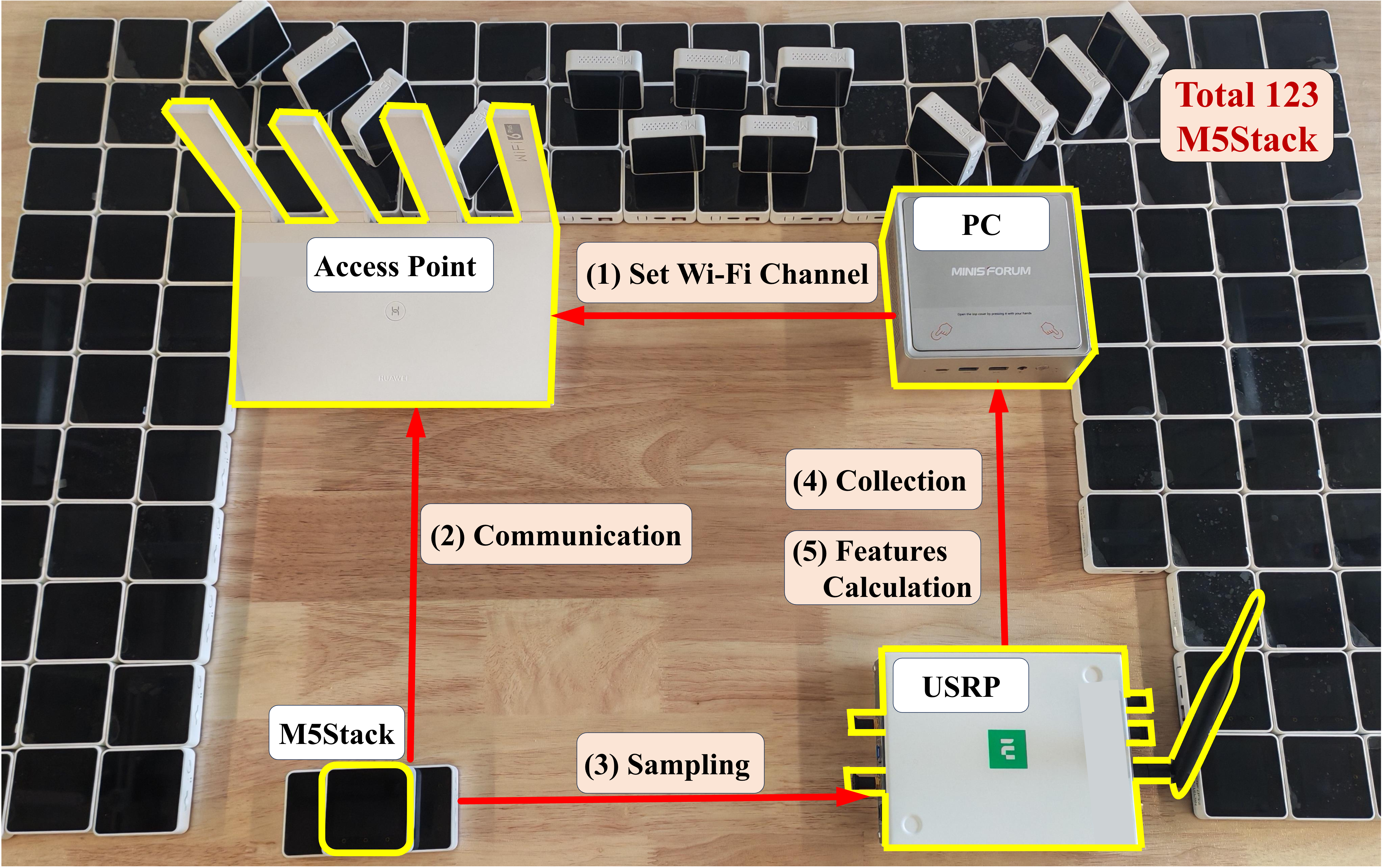 Figure 2. Experimental setup for collecting IEEE 802.11g Wi-Fi preamble I/Q data from many same-model M5Stack Core2 devices in a lab environment.
- Environment
- Lab environments with controlled layouts and interference.
- Office and corridor-like spaces for mobility and multi-path.
- Data Collection
- Measurements from many personal and embedded devices (e.g., over one hundred same-model M5Stack Core2 devices), each recorded over multiple days and sessions.
- Collection of both stationary and mobile traces, with varying distances, orientations, and obstacles.
- Logging of metadata such as timestamp, protocol, device ID, and recording session.
- Dataset Split and Tasks
- Training / validation / test splits that ensure session disjointness (train and test data come from different days / sessions).
- Device-wise splits where a subset of devices is held out and only appears at test time to evaluate unknown-device detection.
- Benchmark tasks for (i) closed-set device classification, (ii) cross-session generalization, and (iii) open-set / unknown-device detection.
- Baselines
- Classical RF fingerprinting methods (e.g., handcrafted features + SVM).
- Deep learning baselines such as CNN-based and Transformer-based models trained on IQ sequences or RF features.
- Conventional biometric or access-control baselines where appropriate in scenario comparisons.
6. Results and Discussion
As the project progresses, we will add detailed quantitative tables, ablation studies, and visualizations of embedding spaces and decision boundaries.
7. Software / Dataset
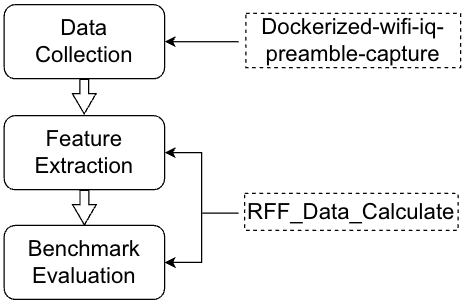
Figure 3. Relationship between the Dockerized data-collection framework, feature-extraction notebook, and the two released datasets.
The following software and datasets are released as companion resources to our arXiv preprint [1] on large-scale RF fingerprinting of IEEE 802.11g same-model devices.
- Dockerized-wifi-iq-preamble-capture – Dockerized GNU Radio framework for IEEE 802.11g Wi-Fi preamble I/Q data collection.
- RFF_Data_Calculate – Kaggle notebook for RF feature calculation and baseline RF fingerprinting experiments.
- RFFI-IQ_only-wifi-802.11g-2.4G-123-m5stack – Kaggle dataset of raw IEEE 802.11g preamble I/Q samples from 123 same-model M5Stack Core2 devices.
- RFFI-kf_feature-IQ-wifi-802.11g-2.4G-123-m5stack – Kaggle dataset of derived RF features aligned with the same devices and frames.
8. Publications
- [1]Zewei Guo, Zhen Jia, JinXiao Zhu, Wenhao Huang, Yin Chen.“A Large-Scale Dataset and Reproducible Framework for RF Fingerprinting on IEEE 802.11g Same-Model Devices.”arXiv 2511.07770 (2025). PDF
- [2]Chen Gong, Bo Liang, Purui Wang, Xiaoyu Ji, Yin Chen, Chenren Xu.“RF-Rock: An Intermodulation-based RFID Unauthorized Identification Attack without Tag Activation.”ACM MobiCom 2025 (2025). PDF
- [3]Takamasa Kikuchi, Koki Shibata, Keiichi Yasumoto, Jinxiao Zhu, Yin Chen.“Poster:Evaluating Effectiveness of Temporal Features and DTW Distance for Radio Frequency Fingerprinting.”ACM MobiCom 2025 (2025). PDF
- [4]Zhen Jia, Wenhao Huang, Zewei Guo, Jinxiao Zhu, Yin Chen.“On the Sensitivity of Wi-Fi RF Fingerprinting under Cross-Channel Scenarios.”IEICE Tech. Rep. BioX2025-86 (2025). PDF
- [5]菊池尊勝, 柴田洸希, 安本慶一, 朱金暁, 陳寅.“無線RF指紋による時系列分類を用いたWi-Fiデバイス識別方法.”BioX研究会 2025 (2025). PDF
- [6]菊池尊勝, 柴田洸希, 安本慶一, 朱金暁, 陳寅.“時系列特徴量とDTW距離を使った無線指紋デバイス識別法とその評価.”BioX研究会 2025 (2025). PDF
- [7]柴田洸希, 菊池尊勝, 安本慶一, 朱金暁, 陳寅.“無線指紋デバイス識別におけるクラスタリングとOne-vs-Rest法を組み合わせた未知デバイス識別法.”BioX研究会 2025 (2025). PDF
- [8]Jia Zhen, Zewei Guo, Wenhao Huang, Yin Chen, Jinxiao Zhu, Xiaohong Jiang.“An Experimental Study on Radio Frequency Fingerprinting-based Authentication in IEEE 802.11g.”BioX Workshop 2024 (2024). PDF
- [9]Xufei Li, Yin Chen, Jinxiao Zhu, Shuiguang Zeng, Yulong Shen, Xiaohong Jiang, Daqing Zhang.“Fractal Dimension of DSSS Frame Preamble: Radiometric Feature for Wireless Device Identification.”IEEE TMC (2023). PDF
- [10]Shuiguang Zeng, Yin Chen, Xufei Li, Jinxiao Zhu, Yulong Shen, Norio Shiratori.“Time-Frequency Fusion for Enhancement of Deep Learning-Based Physical Layer Identification.”Ad Hoc Networks (2023). DOI· PDF
- [11]Shuiguang Zeng, Yin Chen, Xufei Li, Jinxiao Zhu, Yulong Shen, Norio Shiratori.“Visibility Graph Entropy Based Radiometric Feature for Physical Layer Identification.”Ad Hoc Networks (2022). PDF
9. Team
This project is led by the AIoT Lab at Keio University Shonan Fujisawa Campus (SFC), in collaboration with partner laboratories.
10. Supporting Projects
- [SP-JST-MS1]Moonshot Goal 1: Safe and Trusted Avatars, Japan Science and Technology Agency (JST), 2022–2028. “Realization of a society where cybernetic avatars are safe and trusted to use.” Official page
ムーンショット目標1(国立研究開発法人 科学技術振興機構 (JST), 2022–2028)「アバターを安全かつ信頼して利用できる社会の実現」