A city-scale edge-AI and IoT platform that senses fine-grained household waste emissions from garbage truck videos to accelerate data-driven municipal waste reduction.

1. Overview
Gomi Zero Shonan (ごみゼロ湘南 in Japanese) is a research project led by Keio University and Reitaku University since FY2022.
The project aims to build a digital platform for regional waste management, collection, and reduction based on fine-grained waste emission data.
Key ideas:
- Use waste collection videos from garbage trucks to sense per-bag, per-location waste emissions in near real time.
- Equip dozens of garbage trucks in the Shonan area (Kanagawa Prefecture) with small GPU edge computers and convert them into IoT sensing nodes.
- Continuously stream time–space indexed waste data (location, time, number of bags, truck ID, etc.) to a central platform.
- Combine waste emission data with regional, social, and environmental datasets to support data-driven environmental administration and waste reduction policies.
2. Background and Motivation
Municipal solid waste, especially combustible household waste, contributes significantly to:
- CO₂ emissions from incineration and garbage truck operations.
- Landfill pressure due to incineration residues, with the remaining lifespan of final disposal sites averaging around 21 years in Japan.
In Japan, existing waste statistics are typically:
- Aggregated at the national or municipal level (e.g., annual tonnage).
- Based on per-truck measurements at incineration plants.
Limitations:
- No fine-grained data at the level of collection points or routes.
- Municipalities cannot easily analyze waste emissions by neighborhood, household composition, or local events.
- Residents cannot reflect on their own waste emissions relative to similar households.
At the same time:
- Per-capita daily waste emission has stopped decreasing and even shows an increasing tendency since around 2020.
- Per-capita processing cost continues to rise.
- Municipalities face challenges such as limited final disposal sites, labor shortages, and decarbonization demands.
This project addresses these issues by turning garbage trucks into mobile sensing platforms that continuously generate fine-grained, geo-temporal waste emission data.
3. Research Goals
- Fine-grained Waste Sensing
- Sense waste emissions at the level of individual garbage bags and small regions (e.g., collection points, neighborhoods) using video-based edge AI.
- City-scale IoT and Data Platform
- Deploy an IoT and network infrastructure that collects data from dozens of garbage trucks, aggregates it, and supports large-scale analysis.
- Visualization and Analytics for Policy and Operations
- Provide interactive visualizations and analytics tools for municipal officials, collection companies, and residents to support:
- Waste reduction policies,
- Route optimization,
- Behavior change and public engagement.
- Provide interactive visualizations and analytics tools for municipal officials, collection companies, and residents to support:
- Scalable Real-time Edge AI
- Develop real-time edge AI techniques (scheduling, frame selection, model optimization) that can run accurate deep models on resource-limited in-vehicle devices.
4. Technical Approach
4.1 System Architecture
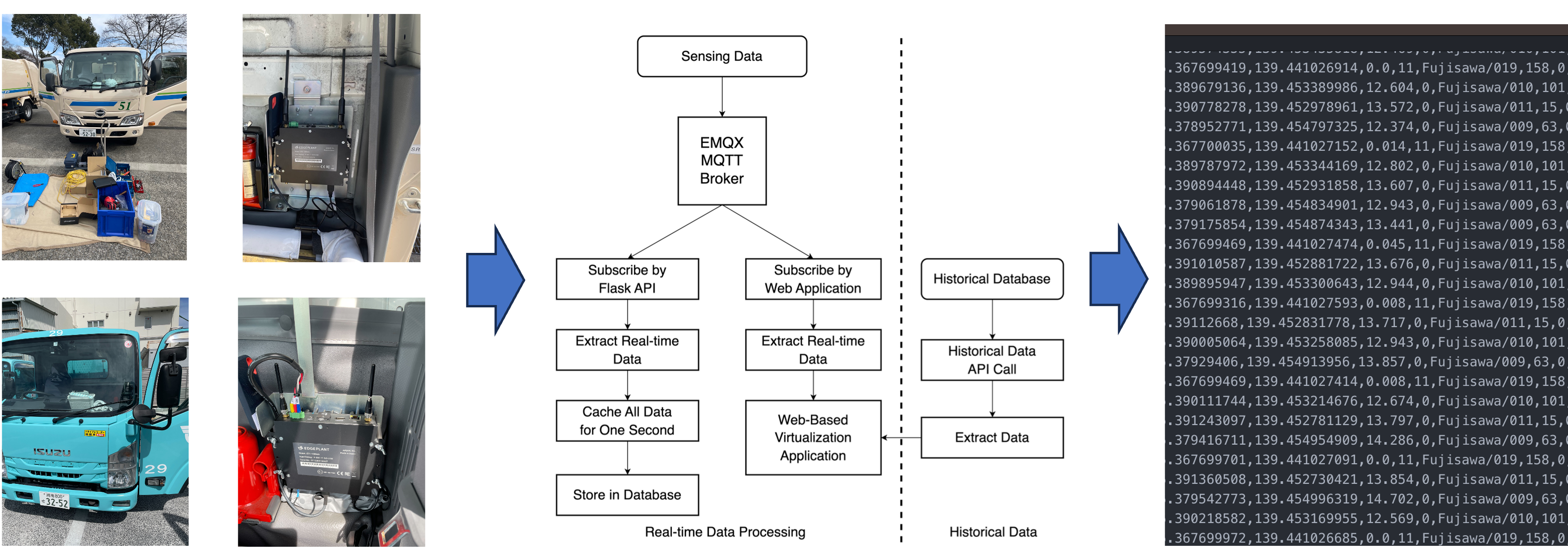
The Gomi Zero Shonan platform consists of three main layers:
- Sensing Layer (On-Truck Edge AI)
- Uses the rear-view camera of garbage trucks to capture waste collection videos.
- Runs deep learning models on embedded GPU edge computers to:
- Detect garbage bags,
- Track their motion,
- Decide whether each bag has been loaded into the truck.
- Combines detection results with GPS location and timestamp to generate fine-grained waste emission records.
- Network Layer
- Transmits sensing results via cellular networks using the MQTT protocol to a central broker.
- Each truck sends messages every 1 second, including:
- Time,
- GPS coordinates,
- Speed,
- Bag counts,
- Truck identifier.
- Visualization and Analytics Layer
- Stores and visualizes waste emission data.
- Supports real-time monitoring, historical playback, and route-based visualization.
- Enables integration with external datasets (e.g., demographics, events, weather) for advanced analytics.
4.2 Core Methods
- Deep Learning-based Bag Detection and Tracking
- Uses object detection models to detect garbage bags (currently focusing on counting, with waste type classification under development).
- Tracks bags across frames and determines when they are loaded into the truck.
- Current prototypes achieve 50–60% counting accuracy, with a target of 90%+ through:
- State-of-the-art detection and tracking algorithms,
- Improved training datasets,
- Better exploitation of temporal information.
- Edge Scheduling for Soft Real-time Processing
- High-accuracy detection models are computationally expensive and cannot process all frames (30 fps) in real time on in-vehicle GPUs.
- The system distinguishes between:
- Collection frames (when workers are loading bags),
- Non-collection frames (e.g., driving between points).
- Strategy:
- Process all collection frames,
- Intermittently process non-collection frames,
- Buffer unprocessed frames and schedule them during less busy periods.
- A key research challenge is designing algorithms that keep end-to-end latency within practical bounds while maintaining high accuracy.
- Scalable Data Management and APIs
- The MQTT-based infrastructure and backend must scale to handle:
- Many trucks
- Multiple municipalities sharing the same platform.
- Future work includes designing APIs that allow selective, cross-municipality queries over accumulated waste data while respecting privacy and access control.
- The MQTT-based infrastructure and backend must scale to handle:
4.3 Implementation
- On-truck Edge Device
- Embedded GPU computer: EdgePlant T1 with NVIDIA Jetson TX2, running Ubuntu 18.04, JetPack 32.7.2, CUDA 10.2, and cuDNN 8.0.
- Uses the existing rear camera of the garbage truck via a video capture module.
- Equipped with:
- GNSS module ,
- 4G communication module
- Deployment and Power
- Edge devices are installed behind the passenger seat to avoid interfering with daily operations.
- Power is supplied from the truck’s engine, with ignition-linked control and a controlled shutdown sequence to protect the system and data.
- Server-side Components
- MQTT broker and data storage servers are hosted at Keio University Shonan Fujisawa Campus.
- Visualization and analysis applications connect to the broker to receive, store, and process data in real time.
5. Experiments and Results
5.1 Bag Detection Video
We deployed the edge-AI system on real garbage trucks in the Shonan area and recorded rear-camera videos during regular collection operations.
The detection model runs on the in-vehicle GPU and draws bounding boxes around garbage bags in real time, while tracking their movement until they are loaded into the truck.
The videos confirm that the system can robustly detect bags under various conditions.
5.2 Data Visualization
From the detection and tracking results, we generate fine-grained waste-emission records with timestamps and GPS coordinates.
These data are visualized on a city map, where each point or segment of a route is associated with the number of collected bags.
The visualization allows municipal officials to quickly identify areas with unusually high or low waste emissions and to explore temporal patterns over days, weeks, or months.
6. Publications and Outputs
- [1]Kazuhiro Mikami, Wenhao Huang, Yin Chen, Jin Nakazawa.“JumpQ: Stochastic Scheduling to Accelerating Object-detection-driven Mobile Sensing on Object-sparse Video Data.”ACM SenSys 2025 (2025). DOI· PDF
- [2]Wenhao Huang, Kazuhiro Mikami, Yin Chen, Jin Nakazawa.“Real-Time Image-Based Automotive Sensing: A Practice on Fine-Grained Garbage Disposal.”IoT Conference 2023 (2023). DOI· PDF
- [3]Yuanze Zhang, Wenhao Huang, Yin Chen, Jin Nakazawa.“Forecasting Household Waste Generation with Deep Learning and Long-term Granular Database.”IoT Conference 2023 (2023). DOI· PDF
- [4]Yin Chen, Jin Nakazawa.“Making Cities Smarter with Regional IoT and the Force of Information.”IEEJ Journal (2021). PDF
- [5]陳寅, 中澤仁.“地域を網羅する IoT と情報の力による街のスマート化.”電気学会誌 (2021). PDF
- [6]三上量弘, 陳寅, 中澤仁.“DeepCounter: 深層学習を用いた細粒度なゴミ排出量データ収集手法.”情報処理学会論文誌 (2020). PDF
- [7]Yin Chen, Jin Nakazawa, Takuro Yonezawa, Hideyuki Tokuda.“Cruisers: An Automotive Sensing Platform for Smart Cities Using Door-to-Door Garbage Collecting Trucks.”Ad Hoc Networks (2019). PDF
- [8]Yin Chen, Mina Sakamura, Jin Nakazawa, Takuro Yonezawa, Akira Tsuge, Yuichi Hamada.“OmimamoriNet: An Outdoor Positioning System Based on Wi-SUN FAN Network.”ICMU 2018 (2018). PDF
- [9]Kazuhiro Mikami, Yin Chen, Jin Nakazawa, Yasuhiro Iida, Yasunari Kishimoto, Yu Oya.“Deepcounter: Using Deep Learning to Count Garbage Bags.”RTCSA 2018 (2018). PDF
- [10]Kazuhiro Mikami, Yin Chen, Jin Nakazawa.“Poster Abstract:Using Deep Learning to Count Garbage Bags.”ACM SenSys 2018 (2018). PDF
- [11]Yin Chen, Takuro Yonezawa, Jin Nakazawa.“Automotive Sensing for Smart Cities: Current Practices and Challenges.”Journal Article (2018). PDF
- [12]Yin Chen, Takuro Yonezawa, Jin Nakazawa, Hideyuki Tokuda.“Evaluating the Spatio-Temporal Coverage of Automotive Sensing for Smart Cities.”ICMU 2017 (2017). PDF
- [13]Yin Chen, Jin Nakazawa, Takuro Yonezawa, Takafumi Kawsaki, Hideyuki Tokuda.“Cruisers: A Public Automotive Sensing Platform for Smart Cities.”IEEE ICDCS 2016 (2016). PDF
- [14]Yin Chen, Jin Nakazawa, Takuro Yonezawa, Takafumi Kawasaki, Hideyuki Tokuda.“An Empirical Study on Coverage-Ensured Automotive Sensing Using Door-to-Door Garbage Collecting Trucks.”Smart Workshop 2016 (2016). PDF
7. Team
This project is jointly conducted by the following laboratories:
8. Supporting Projects
- [SP-NICT]NICT Commissioned Research (ID 22610), National Institute of Information and Communications Technology (NICT), 2022–2025. “Gomi Zero Shonan: Digital platform for regional waste management, collection, and reduction using fine-grained waste emission data.” Official page
NICT 高度通信・放送研究開発 (課題番号 22610)(国立研究開発法人 情報通信研究機構 (NICT), 2022–2025)「ごみゼロ湘南:細粒度なごみ排出量データに基づく地域ごみ処理・収集・削減のデジタルプラットフォーム」 - [SP-K1]JSPS KAKENHI 21K17735, Japan Society for the Promotion of Science (JSPS), 2021–2023. “Study on an intelligent sensing system for fine-grained data of urban garbage discharge.” Official page
科研費 若手研究 21K17735(日本学術振興会 (JSPS), 2021–2023)「細粒度な都市ごみ排出量データのための知的センシングシステムに関する研究」 - [SP-K2]JSPS KAKENHI 17K12677, Japan Society for the Promotion of Science (JSPS), 2017–2018. “Modeling, Design and Implementation of Heterogeneous Opportunistic Urban Sensor Network using Garbage-collecting Trucks as Communication Backbones.” Official page
科研費 若手研究(B) 17K12677(日本学術振興会 (JSPS), 2017–2018)「清掃車を通信基盤とする異種機会都市センサネットワークのモデリング・設計と実装」